
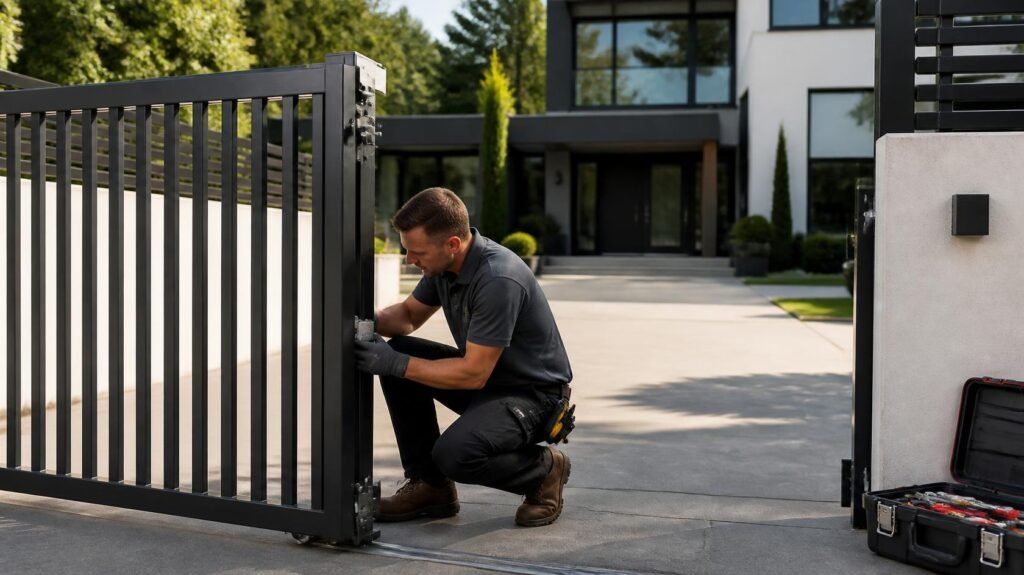
An automatic gate makes it easier to control access to a driveway, home, business, or private property. When it stops opening, reverses unexpectedly, makes unusual noises, or refuses to respond to a remote, it can quickly become more than an inconvenience. It may also create a security concern or a safety hazard.
Automatic gate repair in Folsom, CA, starts with identifying the symptoms and understanding which checks are safe to perform. A gate that will not move could have a power problem, a faulty remote, an obstructed track, a damaged sensor, or an issue with its motor or control board. These symptoms can look similar, so the underlying cause should not be assumed without a proper inspection.
Understanding common automatic gate problems can help property owners recognize warning signs, avoid unsafe troubleshooting, and decide when to call a professional.
This guide explains seven common warning signs, the differences between sliding and swing gate problems, safe troubleshooting steps, repair cost factors, and situations that require professional attention.
If your gate is already malfunctioning, visit our automatic gate repair services in Folsom to learn more about the available service.
1. Seven Common Warning Signs Your Automatic Gate Needs Repair
Automatic gates often provide clues when a component begins to fail. Recognizing these signs early can help prevent additional damage and reduce the risk of operating an unsafe gate.
1. The Gate Will Not Open or Close
A gate that does not respond to the remote, keypad, intercom, or another access-control device may have a power supply issue, a control problem, a failed operator, or an access-control fault.
Start by checking whether the problem affects every control method or only one. If the remote does not work but the keypad does, the issue may be limited to the remote or its battery. If no control method works, the problem may involve the power supply, control board, safety circuit, or gate operator.
Safe initial checks include:
- Confirming that the property’s power has not been interrupted.
- Checking the remote battery and trying another authorized remote, if available.
- Looking for visible obstructions in the gate’s path.
- Checking the exterior of the operator for obvious damage without opening its electrical enclosure.
Do not open electrical panels or attempt internal wiring repairs. If the gate remains unresponsive, arrange a professional inspection.
For assistance with a gate that will not open or close properly, see our automatic gate repair in Folsom.
2. The Gate Starts Moving but Stops Halfway
A gate that begins to move and then stops may be encountering resistance or triggering a safety feature. On a sliding gate, debris in the track, worn rollers, or a damaged guide can interfere with movement. On a swing gate, a binding hinge, sagging gate leaf, or obstruction near the swing path may be responsible.
The operator may also stop because of a sensor signal, an incorrect limit setting, an overloaded motor, or an electrical fault.
Observe the gate from a safe distance. Look for leaves, stones, branches, or other visible debris that can be removed without touching moving parts. If the gate is visibly crooked, dragging, or unusually difficult to move, do not force it through another cycle.
Repeatedly pressing the remote can put additional stress on the operator and mechanical components. A technician can determine whether the problem comes from alignment, resistance, controls, or the operator itself.
3. The Gate Moves More Slowly Than Usual
A noticeable reduction in speed can indicate increased mechanical resistance, a problem with the operator, a power-related issue, or a component that is beginning to wear.
For example, sliding gate rollers may become difficult to move if they are damaged or if the track is obstructed. A swing gate may develop resistance because of worn hinges or changes in alignment. The operator may then struggle to move the gate through its normal cycle.
Weather exposure and operating frequency can also affect performance. Slow movement alone does not confirm that the motor has failed.
Pay attention to whether the gate slows down consistently, only in one direction, or after several operating cycles. That information can help a repair professional narrow down the possible causes.
4. The Gate Makes Grinding, Clicking, or Banging Noises
Unusual sounds often indicate that the gate or operator is no longer working as expected.
- Grinding: May indicate track or roller problems, friction, or worn mechanical components.
- Repeated clicking: May come from a relay, control system, or an operator attempting to start without moving the gate.
- Banging or clunking: May indicate loose hardware, a gate reaching a stop incorrectly, alignment issues, or excessive movement.
- Straining or humming: May suggest that the motor is attempting to operate against resistance, although electrical faults can produce similar symptoms.
Do not assume that every noise means the motor needs replacement. The gate’s mechanical system, operator, and controls should be assessed together.
If the noise is sudden, severe, or accompanied by jerking, visible damage, or a burning smell, stop operating the gate and arrange an inspection.
5. The Gate Reverses Direction or Fails to Close Fully
An automatic gate may reverse or stop when its safety system detects an obstruction or when the operator encounters unexpected resistance. Depending on the equipment, the cause could involve a photoelectric sensor, an edge sensor, incorrect travel limits, mechanical binding, or a control-system fault.
First, check whether an object is visibly blocking the gate’s path. Look at accessible sensor faces from a safe position to see whether dirt or debris is covering them. Follow the manufacturer’s instructions for exterior cleaning.
Do not cover, disconnect, bypass, or reposition safety devices simply to make the gate close.
If the gate continues reversing with a clear path, or if it closes past its intended stopping point, stop using it until the problem can be assessed. A malfunctioning safety system or incorrectly adjusted limit can expose people, pets, and vehicles to danger.
6. The Remote, Keypad, or Intercom Works Intermittently
Access-control issues can be frustrating because they may appear and disappear without warning.
Possible causes include:
- A weak remote battery.
- Radio interference or reduced signal range.
- Damaged remote buttons.
- A keypad with worn or malfunctioning buttons.
- A power or communication issue affecting the access-control system.
- A faulty receiver, wiring connection, or control board.
If only one device is affected, test another authorized entry method if one is available. If several devices fail at the same time, the issue may be further downstream in the control system.
Avoid repeatedly entering codes or changing system settings without understanding the equipment. For persistent faults, gate opener repair in Folsom may be relevant, depending on the diagnosis.
7. The Gate Becomes Crooked, Jerks, or Stops Unevenly
A gate that tilts, shakes, scrapes, or moves unevenly may have a mechanical problem that needs prompt attention.
On a sliding gate, possible causes include damaged rollers, a misaligned track, worn guides, or loose mounting hardware. On a swing gate, possible causes include hinge wear, a sagging gate leaf, a damaged support, or problems with the operator arm.
A crooked gate should not be treated as a simple remote or motor issue. Continuing to operate it can increase the load on the operator and worsen the mechanical damage.
Keep people and vehicles clear of the gate’s movement area. Do not attempt to lift, straighten, or manually force a heavy gate into position. A technician should inspect the structure, supports, movement, and operator before deciding which components need repair.
2. Common Mechanical, Electrical, and Access-Control Problems
An automatic gate is a system of connected components. A fault in one part can affect the entire gate, so the visible symptom does not always identify the failed component.
Mechanical Problems
Mechanical components support and guide the gate as it moves. Depending on the design, these may include tracks, rollers, hinges, guide brackets, wheels, chains, belts, racks, and mounting hardware.
Common mechanical issues include:
- Debris or damage affecting a sliding gate’s track.
- Worn rollers that create friction or uneven movement.
- Loose or damaged hinges on swing gates.
- A gate leaf that has shifted or sagged.
- A damaged drive chain, belt, or gear rack.
- Corrosion or structural wear that affects alignment.
A motor should not be expected to compensate for a gate that binds or moves unevenly. Increasing force or changing settings without correcting the mechanical problem can create additional damage and safety risks.
Electrical and Operator Problems
The gate operator is the powered mechanism that moves the gate. It may contain a motor, gears, drive components, and control electronics, depending on the model.
Possible electrical or operator-related issues include:
- Loss of power or a tripped circuit.
- A failed power supply or backup battery.
- Damaged wiring or a loose connection.
- A malfunctioning control board.
- Motor overheating or internal failure.
- Faults in the operator’s safety inputs.
- Incorrectly configured travel limits.
These problems require different diagnostic approaches. For example, a motor that hums without moving may be struggling against mechanical resistance or experiencing an electrical fault. It is not enough to conclude that the motor needs replacement based on sound alone.
Access-Control Problems
Access-control equipment determines who can activate the gate. It may include remote transmitters, keypads, card readers, telephone entry systems, intercoms, and receivers.
When access is intermittent, the issue might be the individual device, the signal path, the receiver, its power supply, or a connection to the gate controller.
For a shared driveway or commercial entrance, document which devices work and which do not. This simple observation can help the technician distinguish an access-control fault from a broader gate operator problem.
3. Automatic Gate Troubleshooting Table
The following table is a starting point for identifying symptoms, not a substitute for a technical inspection.
| Symptom | Possible Causes | Safe Initial Check | Recommended Action |
|---|---|---|---|
| Gate does not respond | Power interruption, remote battery, control fault | Test another authorized control method | Arrange service if multiple controls fail |
| Gate stops halfway | Obstruction, track resistance, sensor fault | Look for visible debris from a safe position | Call a technician if movement remains abnormal |
| Gate moves slowly | Worn rollers, hinge friction, operator problem | Observe movement without approaching the gate | Request mechanical and operator inspection |
| Gate reverses unexpectedly | Sensor activation, obstruction, limit or control fault | Check for visible obstructions and dirty sensor faces | Do not bypass sensors; arrange diagnosis |
| Grinding or banging noise | Track, roller, hinge, gear, or alignment issue | Listen from a safe distance and note when it occurs | Stop operation if noise is severe or movement is erratic |
| Keypad or remote fails | Battery, signal, receiver, wiring, or device fault | Check the battery or try another authorized control | Seek access-control diagnosis if the fault persists |
| Gate appears crooked | Damaged rollers, hinges, supports, or alignment | Visually inspect without touching or lifting the gate | Stop operating and arrange professional repair |
| Gate will not close fully | Sensor fault, obstruction, limit issue, mechanical resistance | Check the visible path and accessible sensor faces | Contact a technician if the issue continues |
| Operator hums but gate stays still | Mechanical binding, drive fault, or electrical issue | Stop repeated activation attempts | Have the operator and gate mechanism inspected |
| Gate works intermittently | Loose connection, heat-related fault, receiver issue, or worn component | Record when the problem occurs | Give the technician the symptoms and timing |
The same symptom can have multiple causes. A technician may need to inspect the gate’s movement, operator, safety devices, and control inputs before recommending a repair.
4. Sliding Gate Repair vs. Swing Gate Repair
The design of your gate affects how it can fail and what a repair may involve.
Sliding Automatic Gates
Sliding gates move sideways along a track or a guided path. Some designs are cantilevered and do not use a ground track in the same way as conventional track-mounted systems.
Common problems include debris buildup, damaged rollers, alignment issues, chain or rack wear, guide problems, and operator faults.
If the gate scrapes, jerks, or stops at a particular point, the movement path and drive system should be inspected. Learn more about sliding gate repair in Folsom.
Swing Automatic Gates
Swing gates rotate on hinges, much like doors. They may have one gate leaf or two, with operators mounted on posts or connected to the gate using arms or other drive mechanisms.
Common problems include worn hinges, sagging gate leaves, obstructed swing paths, damaged operator arms, and uneven movement between two leaves.
Check for visible obstructions, but do not push or pull a heavy gate to test its resistance. For relevant service information, see swing gate repair in Folsom.
Which Type of Gate Is Easier to Repair?
There is no universal answer. A straightforward remote-control issue may be relatively simple on either design, while structural damage or a failed operator can require considerably more work.
Repair complexity depends on the gate’s weight and dimensions, its condition, the operator model, the availability of replacement parts, and the accessibility of the damaged component.
A gate that is no longer aligned should be assessed mechanically before an operator is adjusted or replaced. Otherwise, a new or repaired motor may continue to experience excessive resistance.
5. Gate Opener, Motor, Remote, Keypad, and Sensor Problems
Several components work together to operate an automatic gate. Understanding their roles helps property owners describe a problem more accurately.
Gate Opener and Motor
The motor provides power, while the operator’s drive mechanism transfers that power to the gate. Depending on the model, this may involve gears, a chain, a belt, a screw drive, or an arm mechanism.
A gate that will not move may have a motor or drive problem, but the cause could also be an obstruction, a safety input, a power issue, or a mechanical fault.
Gate motor troubleshooting should begin with external observations, not opening the operator enclosure. Note any indicator lights or error codes visible without removing covers, and provide that information to the repair technician.
For issues involving the powered opening system, explore gate opener repair in Folsom.
Control Board and Travel Limits
The control board receives commands and coordinates the operator’s actions. Depending on the model, it may monitor safety devices, manage opening and closing cycles, and provide diagnostic indicators.
Travel limits tell the system where the gate should stop at its open and closed positions. Incorrect settings, a faulty limit mechanism, or a change in the gate’s alignment can cause incomplete travel or improper stopping.
Do not adjust limits simply to force a damaged or binding gate to complete a cycle. The mechanical condition and safety system must be considered first.
Remote Control and Keypad
A remote usually sends a wireless command to a receiver. A keypad provides an access code or another authorized input. If one device fails while others continue to work, the fault may be limited to that device or its communication path.
Safe checks include replacing a remote battery according to its instructions and confirming that you are using an authorized code. If multiple access devices stop working, the problem may be at the receiver, control board, or power supply.
Avoid sharing access codes with unauthorized people or repeatedly resetting equipment without knowing how the system is configured.
Automatic Gate Sensors
Automatic gates may use photoelectric sensors, safety edges, vehicle-detection loops, or other devices to detect obstructions or provide safety-related signals.
- Photoelectric sensors use a beam of light to detect an interruption in the monitored path.
- Safety edges detect contact or pressure along a protected edge.
- Vehicle-detection loops can detect vehicles in designated areas, depending on the system’s design and configuration.
A sensor fault may prevent the gate from closing, cause it to stop, or trigger a reversal. Sensor behavior depends on the specific operator and how the system is configured.
Never bypass a sensor or disable an entrapment-protection device to restore operation.
6. Safe Troubleshooting Steps Property Owners Can Perform
Before arranging service, a few limited external checks may help identify the general nature of the problem. Perform them only if the gate is stationary, the area is safe, and you can observe the system without entering its movement path.
What You Should Not Attempt
Do not:
- Reach through or over a gate to operate controls.
- Stand in the gate’s path while testing it.
- Push or pull a heavy gate that appears jammed or misaligned.
- Remove motor covers or work on live wiring.
- Bypass photo eyes, safety edges, or other entrapment-protection devices.
- Change force settings or travel limits to overcome resistance.
- Remove chains, gears, or other loaded drive components.
- Continue operating a gate that jerks, scrapes, or behaves unpredictably.
If the gate cannot be operated safely, stop troubleshooting. Leave the system out of service where it is safe and practical to do so, and contact a qualified gate technician.
7. Problems That Require a Qualified Gate Technician
External checks can help narrow down symptoms, but many faults require diagnostic equipment, technical knowledge, and access to manufacturer-specific instructions.
Arrange professional service when you notice any of the following:
- The gate is crooked, sagging, or coming off its track.
- A hinge, roller, chain, gear, support, or operator arm appears damaged.
- The motor repeatedly stops, overheats, or makes unusual sounds.
- A circuit breaker trips repeatedly or there is visible electrical damage.
- Safety sensors fail or the gate reverses unpredictably.
- The gate does not stop at the correct open or closed position.
- Multiple access-control devices fail at the same time.
- The gate moves without a clear command or behaves inconsistently.
- A commercial entrance is stuck in a position that creates an access or security issue.
A professional assessment should consider the complete system rather than automatically replacing the component that appears to be malfunctioning.
For example, if a motor struggles because a sliding gate has damaged rollers, replacing the motor alone may not solve the underlying problem. Similarly, changing a travel limit will not correct a gate that is structurally out of alignment.
Depending on the diagnosis, electric gate repair in Folsom may be the relevant service.
8. Automatic Gate Safety: When to Stop Operating the System
Automatic gates are heavy moving structures. Their closing edges, hinges, rollers, drive mechanisms, and surrounding spaces can create pinch, crush, or entrapment hazards.
Stop Using the Gate If:
- A person, pet, or object could become trapped.
- The gate closes when its safety system should prevent movement.
- The gate reverses unpredictably or fails to stop correctly.
- The gate is visibly unstable or at risk of coming off its supports.
- There is smoke, a burning smell, exposed wiring, or electrical damage.
- The operator or gate has suffered an impact that may have damaged its structure.
Keep people away and do not repeatedly activate the gate to see whether the problem clears. If an electrical hazard is suspected, do not touch the operator or nearby wiring. Contact a qualified professional; if there is an immediate threat to life or fire, contact the appropriate emergency services.
Keep People Clear of Moving Parts
Children should never play near an automatic gate or use its remote controls as toys. Controls should be positioned and used in accordance with the system’s safety instructions so the operator can be activated from a safe location with a clear view of the gate.
For an older installation, a qualified gate professional can assess the condition of the gate and whether its operator and entrapment-protection equipment are appropriate for the system. Do not assume an older gate has the same safety features as a newer one.
9. What Affects Automatic Gate Repair Costs in Folsom?
The cost of automatic gate repair varies with the type of failure, the gate’s construction, and the parts and labor needed. Without an inspection and details about the system, quoting a specific price would be unreliable.
Type of Problem
A remote battery or an isolated access-control issue may require less work than structural damage, a failed operator, or a control board replacement. The actual cost depends on the diagnosis and the equipment involved.
Gate Type, Size, and Weight
A large sliding gate or a heavy double swing gate may require different parts, more adjustment, and more labor than a smaller, simpler system. The gate’s material and condition also matter.
Replacement Parts and Availability
The price of a motor, control board, receiver, safety sensor, roller, chain, or other component varies by model. Older or discontinued equipment may be more difficult to source.
Installation Condition
A gate with damaged posts, misaligned supports, poor drainage, or a deteriorated track may need additional work beyond the original fault. Correcting the underlying issue can be essential to a lasting repair.
Access and Diagnostic Time
The location of the operator, condition of the wiring, accessibility of components, and complexity of the access-control setup can affect the time needed to diagnose and complete a repair.
Repair or Replacement Scope
Some faults can be addressed by repairing a component. Others may reveal broader wear, outdated safety equipment, or structural problems that make replacement worth considering.
Before authorizing work, ask the provider to explain the diagnosis, proposed repair, parts and labor included, and whether any additional work may be needed. Request a written estimate when appropriate, and clarify whether diagnostic or service-call fees apply.
10. Should You Repair or Replace an Automatic Gate?
Repair is often worth considering when the gate structure is sound and the problem is limited to a replaceable or repairable component. Replacement may be more practical when damage is extensive, the system is repeatedly failing, or necessary parts are no longer available.
| Consideration | Repair May Make Sense When… | Replacement May Make Sense When… |
|---|---|---|
| Gate structure | The frame, supports, and movement path are in good condition | Structural damage or corrosion is extensive |
| Operator | The fault is isolated and compatible parts are available | The operator is badly damaged or unsuitable for the system |
| Frequency of problems | The issue is occasional and the underlying cause can be corrected | Repeated failures continue despite appropriate repairs |
| Safety | The system can be restored to safe operation | Important safety shortcomings cannot be adequately addressed through repair |
| Parts availability | Suitable replacement components can be sourced | Critical components are discontinued or impractical to obtain |
| Overall cost | The repair is reasonable relative to the system’s condition | Multiple major components need work and replacement offers better long-term value |
A technician should assess both the gate structure and the operator before recommending replacement. Installing a new operator on a damaged, binding gate may leave the original problem unresolved.
If the existing gate is beyond practical repair, automatic gate installation in Folsom provides information about the installation service. The right option depends on the property’s access needs, the gate’s condition, and applicable safety requirements.
11. Preventive Automatic Gate Maintenance
Regular maintenance can help identify wear and obstructions before they lead to a breakdown. The correct maintenance schedule depends on the manufacturer’s instructions, operating frequency, weather exposure, and whether the gate serves a home or a busy commercial property.
Keep the Movement Path Clear
Inspect the visible path for branches, stones, leaves, and other debris. For a sliding gate, pay attention to the track and the areas where the gate travels. For a swing gate, check for new obstructions in its arc.
Remove only loose debris that is safely accessible while the gate is stationary. Do not reach into pinch points or remove guards.
Watch for Changes in Movement
Notice whether the gate begins to move more slowly, shakes, stops at a different position, or makes a new noise. Small changes can indicate wear or increased resistance.
Avoid adjusting force or travel settings yourself to compensate for these symptoms.
Keep Accessible Exterior Surfaces Clean
Dirt and debris can interfere with some sensor types. Follow the manufacturer’s instructions when cleaning accessible sensor faces and exterior surfaces. Do not change the sensor’s position or disconnect its wiring.
Check for Visible Damage
From a safe position, look for obvious damage to the gate frame, supports, track, hinges, exposed fasteners, and operator housing. If anything appears loose, bent, cracked, or unstable, stop operating the gate and arrange an inspection rather than attempting a repair yourself.
Follow the Manufacturer’s Maintenance Instructions
Lubrication requirements differ between gate designs and components. Some parts require specific lubricants, while others may not need lubrication at all. Applying the wrong product can attract debris or damage components.
Use the operator’s manual as the primary guide and ask a technician which maintenance tasks are appropriate for your particular system.
Maintain Access-Control Devices
Replace remote batteries as needed, protect keypads from damage, and keep access codes secure. If an entry device works intermittently, address the issue instead of relying on repeated attempts to activate the gate.
Schedule Professional Inspections When Appropriate
A qualified technician can inspect mechanical wear, mounting hardware, the operator, safety devices, electrical components, and control settings. This is particularly useful for gates with frequent daily cycles or systems that protect commercial entrances.
For an overview of the company’s service options, visit the Sky Automatic Gates and Access Control services page.
12. How to Choose an Automatic Gate Repair Provider in Folsom
The right repair provider should be able to explain the problem clearly, identify safety concerns, and recommend work that addresses the underlying cause.
Before choosing a company, consider the following:
- Relevant experience: Ask whether the provider works with your gate type and operator model.
- Clear diagnosis: The technician should explain the suspected cause and what needs to be inspected before confirming a repair.
- Transparent pricing: Ask about diagnostic fees, parts, labor, and the process for approving additional work.
- Safety awareness: Confirm that the provider will inspect relevant safety devices rather than bypassing them to restore operation.
- Parts and compatibility: Replacement components should be appropriate for the specific operator and gate system.
- Communication: The provider should explain the repair options, limitations, and any follow-up maintenance that may be needed.
- Appropriate qualifications: Ask about relevant licensing, insurance, and training where applicable, and verify claims rather than assuming they are held.
A trustworthy provider should not guarantee that a particular part has failed without a reasonable diagnosis. Nor should a repair proposal ignore an unsafe gate structure or malfunctioning entrapment-protection equipment.
You can learn more about Sky Automatic Gates and Access Control and use the company’s contact page to discuss your gate issue.
13. Frequently Asked Questions About Automatic Gate Repair in Folsom
1. What Are the Most Common Automatic Gate Problems?
Common problems include power interruptions, failed remotes, sensor faults, obstructed tracks, worn rollers or hinges, operator malfunctions, control-board faults, and incorrect travel limits. The cause depends on the gate design and the symptoms.
2. Why Is My Automatic Gate Not Opening?
Possible causes include a power issue, a depleted remote battery, an access-control fault, a triggered safety device, or a problem with the operator. Try another authorized control method and check for visible obstructions. If the gate remains unresponsive, arrange a professional diagnosis.
3. Why Does My Automatic Gate Open but Not Close?
The gate may be detecting an obstruction, receiving a safety-sensor signal, encountering mechanical resistance, or experiencing a control or limit-setting fault. Check for visible obstructions from a safe position, but do not bypass sensors to force the gate closed.
4. Can I Repair an Automatic Gate Myself?
You can perform limited external checks, such as replacing a remote battery according to its instructions or observing visible debris. Repairs involving electrical components, operator mechanisms, structural alignment, or safety devices should be handled by a qualified professional.
5. Why Is My Automatic Gate Making a Grinding Noise?
Grinding may indicate friction, damaged rollers, a track issue, worn drive components, or misalignment. Stop operating the gate if the sound is severe or the movement is abnormal. An inspection is needed to determine the actual cause.
6. How Much Does Automatic Gate Repair Cost in Folsom?
Costs depend on the diagnosis, gate type, parts, labor, access to the damaged components, and whether structural repairs are needed. Ask for an estimate that explains the proposed work and any diagnostic or service fees before authorizing the repair.
7. Is It Safe to Keep Using a Gate That Reverses Unexpectedly?
Not if the cause is unknown or the gate behaves unpredictably. A reversal can be a response to a safety device, an obstruction, or a fault. Do not disable the safety system; stop using the gate if safe operation cannot be assured and contact a technician.
8. Is Sliding Gate Repair Different From Swing Gate Repair?
Yes. Sliding gates rely on a guided sideways movement system, which may include tracks, rollers, guides, and drive components. Swing gates rotate on hinges and may use operator arms. Each design has different mechanical issues and repair requirements.
9. How Can I Prevent Automatic Gate Breakdowns?
Keep the movement path clear, observe changes in speed or noise, maintain accessible exterior surfaces according to the manufacturer’s instructions, protect access-control devices, and arrange professional inspections when needed. Maintenance should match the equipment and how frequently it is used.
10. When Should I Replace an Automatic Gate Instead of Repairing It?
Replacement may be appropriate when the gate has extensive structural damage, major components are unavailable, failures are recurring, or safety issues cannot be adequately corrected through repair. A qualified technician can compare the condition, repair scope, and replacement options.
14. Summary: What to Do When Your Automatic Gate Stops Working
Automatic gate problems can originate in the mechanical movement system, electrical supply, operator, safety sensors, or access-control devices. A remote that fails, a gate that stops halfway, or an unusual noise is a symptom—not a confirmed diagnosis.
Keep these key points in mind:
- Check visible obstructions and simple external controls only when it is safe to do so.
- Note when the problem occurs and which controls still work.
- Do not force a gate that is crooked, jammed, or moving unpredictably.
- Never bypass safety sensors or work on live electrical components.
- Have damaged structures, operator faults, and safety-system problems inspected by a qualified technician.
- Compare repair and replacement options based on the gate’s condition, compatible parts, safety, and total scope of work.
For property owners looking for Automatic Gate Repair Folsom, a proper diagnosis can help identify the underlying fault and determine the appropriate next step.